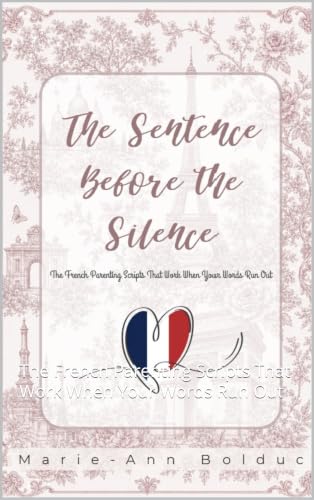
Most parenting books work on a parent's philosophy. This one works on a parent's sentences, on the theory that the belief was never the problem. A parent already knows they should stay calm at bedtime. What fails is the actual line that comes out of their mouth two seconds after the refused dinner or the shrieking from the next room, when the philosophy has nothing left to offer and only a script will do.
The book is built around le cadre, the French practice of holding a small number of rules absolutely while leaving real freedom inside them. Marie-Ann Bolduc, raising children between New York and Paris, watched this frame hold a firm and quiet line in French households that she could recognize in action but not yet reproduce, until she traced the pattern down to the level where it actually operates: the exact words, in the exact order, said in the exact tone.
Each chapter takes one recurring flashpoint, the bedtime encore, the refused dinner, the supermarket meltdown, the shoes that will not go on, and supplies the sentence that holds the line without turning into a negotiation or a punishment. The book explains why these specific sentences work: they remove the parent's own uncertainty from the exchange, so a child stops testing whether the rule is real. A rule stated with hesitation invites a renegotiation. A rule stated once, in a settled voice, does not.
The scripts are calibrated by age and by how frayed the parent already is at that moment, because the sentence that works at six in the evening after a full day is not the sentence a depleted parent can actually deliver at eight. The book is honest about the cost of this approach too: holding a frame consistently is harder in the first two weeks than giving in, and children test the frame precisely to find out whether it is real before they stop testing it. Readers get the specific line for that moment as well, because a method without a fallback teaches a parent that they failed rather than that the moment was simply hard.
Named Frameworks in This Book
- —Le Cadre (The Frame)
- —The Firm Quiet Line
- —The Supermarket Script